
Nature: The Foundation for Painting
Continuing our lesson from last month where we explore the strong case for the observation of nature as a basis for a painter’s training. From Giotto to Pollock we are exploring the implications of the observation of nature, its rendering and distillation.

Defining Nature
As a way of defining what nature is, we can divide it into two parts:
-
The tactile world – all living and physically observable things together with the elements of their construction.
-
The intangible world – emotional, spiritual, intellectual forces which are observable indirectly through gesture and facial expression of humans and animals.
In our last blog, we discussed Giotto and his contribution through his dedicated adherence to the observation of nature.
Today we discuss another ‘son of nature’:
Tommasco di Giovanni Masaccio (1401–1428), considered by many influential intellectuals of his time to have brought the greatest perfection to art and was responsible for refining the modern style of painting with lifelike figures with three-dimensionality.
To achieve ‘naturalism’, Masaccio used a variety of means derived from the observation of nature. These include:
-
The use of tone to mould form more naturalistically.
-
Foreshortening – gives the illusion of depth by creating the object as if it is front-on and receding into the background.
-
Aerial perspective – using colour, allowing warm colours like red to drop out of the picture as the perspective dissolves into the background.
-
One-point perspective – although one-point perspective is criticized for not being fully naturalistic (as we have two eyes), it was an enormous step forward toward the two-point perspective we now understand and see in the visual world.
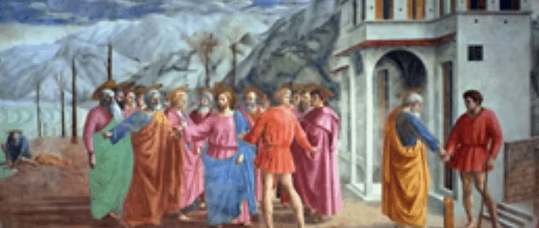
The Tribute Money, 1425 – Fresco by Masaccio
Masaccio’s Tribute Money (1425), fresco situated in the Brancacci Chapel, Florence, demonstrates how the gestures and attitudes of the figures reflect a concentrated interest in proceedings and give credence to the psychological and physical representations.
-
St. Peter’s crouching gesture exudes energy as he takes the coins out of the fish’s mouth and again as he pays the money to the greedy tax collector.
-
Masaccio’s use of the observation of nature is clearly identified when he uses the horizon line to place the general level of the heads of the figures at approximately the same level.
-
Using the horizontal line and the accompanying architecture, Masaccio creates a powerfully convincing focal point through the head of Christ.
Probably the most significant aspect attributed to the observation of nature in this fresco is the use of aerial perspective. By creating foreground, middle ground, and background with diminishing figures and a diminishing colour range (when the reds drop out in the picture plane), Masaccio has created a ‘real’ pictorial space for the figures.
Conclusion
Masaccio provides a further stepping stone in understanding how we see and observe nature, as it provides many and varied clues for our use and gain in our painting life.
#billy