
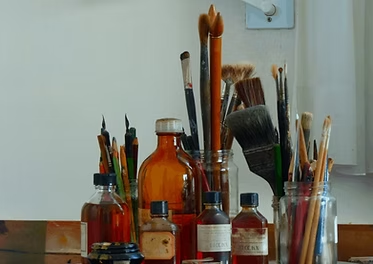
As I discussed in my previous weekly insight, oil paint is extremely flexible — and this flexibility comes from its composition.
Oil paint is made up of three main components:
-
Coloured powder pigment
-
Oil (usually linseed oil, which carries the pigment and binds it together)
-
A diluent (usually pure turpentine, which controls the consistency)

Medium: Oil Paint Tubes
Here, I will guide you through four different oil paint consistencies and their technical uses.
The Four Consistencies of Oil Paint
1. Wash
To begin a painting, use paint thinned with additional pure turpentine.
A wash is very fluid and transparent — you can see the white canvas through it. It is ideal for blocking in shapes and establishing composition in the early stages.
2. Lean Paint
Lean paint consists of thin layers containing little oil. It includes a lean medium (low oil content).
When applied to the canvas, it is thin but has more colour strength than a wash. This consistency is commonly used in alla prima (wet-on-wet) painting.
3. Fat Paint (Impasto)
Fat paint is very thick — often used straight from the tube. It has a buttery, smooth texture that holds crisp shapes.
It can also be mixed with a medium containing more oil to increase richness and flexibility. Fat paint is typically used in the final build-up stages, applied over thin washes or lean paint layers.
4. Encaustic
By adding melted wax (usually beeswax), oil paint gains greater bulk.
The same amount of oil paint can be extended up to twice its volume, creating a thick impasto effect with enhanced texture and body.
Three Methods of Oil Painting
There are three fundamental methods of oil painting:
1. Alla Prima
The “in one go” method uses wash, lean, fat impasto, and encaustic consistencies in a single session.
Alla prima allows the artist to manipulate the paint over the entire surface of the canvas at once. Although changes can be made once the painting is completely dry, the essence of alla prima is to capture the subject or moment in one wet-on-wet attempt.
This method produces a spontaneous, free-flowing style. It captures the essence of the subject rather than creating a highly controlled wet-on-dry work.
A helpful tip:
Stop before you feel completely finished — or get a friend to take the brush out of your hand. Let the painting rest. When you return to it, think carefully before making changes. There is something very special and unique about that captured moment in time — something that cannot be recreated.
The famous 9 x 5 cigar box paintings by Arthur Streeton and other artists of the Heidelberg School demonstrate the brilliance of this method.
2. The “Fat Over Lean” Method
This is a slower, layered approach using lean, fat, and encaustic consistencies.
You begin with thinner paint that contains less oil (lean paint), then gradually build up layers using mediums with increasing oil content (fat paint). This principle is known as “fat over lean.”
Each layer must dry thoroughly before applying the next. Oil paint dries through oxidation. As it oxidises, pigment skins form and lock the surface. If underlying layers are unstable or too oily, cracking, pooling, or surface rippling can occur.
Proper layering prevents structural problems in the finished work.
3. The Glazing Method
This is another slow, controlled method involving a series of thin, transparent layers of paint mixed with additional oil medium.
Each glaze must dry completely before the next is applied.
Because the layers are transparent, light passes through them and reflects back — creating depth similar to a reflective pool of water or a mirror. However, adding white paint will block light transmission and reduce the luminous effect.
Drying Time & Control
Oil paint dries more slowly in humid and cooler weather conditions. You can use this to your advantage, depending on the effect you wish to achieve.
There are also various mediums available to enhance drying times.
As you continue painting, you will develop greater control by understanding the unique qualities and drying times of each oil paint colour — since each pigment behaves differently.
#oilpainting #oilpaints #onlinepaintingclassesBilly